DocuClip Studio › Archival newspaper animation
Browser tool
Archival newspaper animation for history videos
An old front page tells the viewer what people read on the day it happened. DocuClip Studio turns that page into a shot: the paper ages, the camera glides in, and a marker picks out the line your narration is about, from text you type or a scan of a public-domain archive page.
⚡ Customize This Sample Free in Studio (Sign In Free) →
Opens the 1973 Oil Embargo Front Page sample in the studio after a free sign-in (e-mail sign-in, no card).
Two ways to start
Type the headline and the article, and the page is typeset live as an aged broadsheet, a modern journal or a typewritten archive page, with paper grain, ink bleed and worn edges. Or use a scan: upload an image of a page from a public archive in screenshot mode and drag boxes over the lines to highlight. The image is processed in your browser and is not uploaded.
What makes it look archival
Photos dropped onto a typeset page are screened into the dot pattern of old newsprint, so a modern photo sits on the page like one printed decades ago. The paper colour, the column layout and the masthead style change with the layout you pick. The built-in mastheads are fictional, so a typeset page never imitates a real newspaper’s name or logo.
The sample
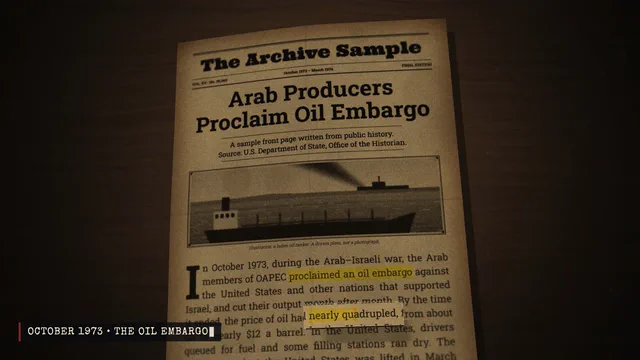
The sample on this page is a historical front page from the 1973 oil embargo: an aged broadsheet, a slow 3D push-in and a marker sweep over the key line. Open it, replace the headline and the article with your own sourced text, choose up to five phrases to highlight, and re-time the sweep to your voiceover.
Finding public-domain pages
Many national libraries publish digitised newspapers with their copyright status marked, and in many countries older newspapers have passed into the public domain. Check the status of the page you use where you publish, credit the archive in your description, and keep quoted wording exact. If you only need the words, type them into a typeset page and name the original newspaper and date in your narration or on screen.
Label what you rebuilt
A page you typeset yourself is a reconstruction, not a document from the archive. Say so on screen or in the description, for example with a small “Reconstruction” caption in a corner of the frame, and keep the original paper, its date and its exact wording in your sources. Viewers trust a channel that shows where each quotation came from, and a clear label keeps a retelling of history from being mistaken for a scan of the real page.
Right to left and long articles
Arabic and Hebrew pages are typeset and highlighted from right to left, and the marker sweeps in reading order. A long article reflows across the columns as you edit, and the camera keeps both margins in frame as it pushes in, so fine print stays readable on a phone.
Export and plans
Pages export as MP4 in 16:9, 9:16 or 1:1. Creator exports 1080p at up to 60 fps, clips up to 60 seconds; Studio Pro exports 4K at 60 fps and transparent WebM, so the page can float over your own footage, and adds archival document-callout and market-bulletin layouts. The free Free Explorer previews every layout under a watermark and exports no files.
How it compares
| Feature | DocuClip Studio | Pan and zoom over a scan | After Effects template |
|---|---|---|---|
| Source | Typed text, or a scan you upload | A scan | The template’s placeholders |
| Highlight | A marker sweeps up to five phrases, timed to the words | Masked by hand | Built into the template |
| Camera | 3D push-in that keeps both margins in frame, with focus | Pan and zoom only | Built into the template |
| Photos | Screened into newsprint dots to match the page | As printed | Depends on the template |
| Right-to-left text | Yes (Arabic and Hebrew) | As printed | Depends on the template |
Last reviewed November 2026. This comparison describes how each product works, not its price, and is not based on hands-on benchmarks. Features change, so check the vendor’s own site before you decide. Product names belong to their owners; DocuClip Studio is not affiliated with them.
When another tool is better. A plain pan and zoom over a real scan is the better choice when the original page itself is the evidence: nothing is more convincing than the document as it was printed.
Questions
- Can I use a real historical newspaper page?
- Yes, upload a scan in screenshot mode. Check its copyright status where you publish and credit the archive; many older pages are in the public domain.
- Are the mastheads real newspapers?
- No. The built-in mastheads are fictional, so a typeset page never imitates a real newspaper. Name the real paper in your narration when you quote it.
- How many phrases can I highlight?
- Up to five per page. The marker sweeps them in order, each at its own moment on the timeline.
- Which plan do I need?
- Opening and a watermarked preview are free with a Free Explorer account. Exports start with Creator; 4K, transparent WebM and the archival document-callout layouts come with Studio Pro.
Free to explore, paid to export
- Free Explorer ($0): a free account (e-mail sign-in), no card. Every sample and engine in a watermarked 540p preview at 24 fps (globe scenes are shown flat), 3 custom AI prompts and the pre-rendered sample NLE pack; no file exports.
- Creator ($19 a month or $149 a year): watermark-free 1080p exports at up to 60 fps (no export credits; fair use applies), clips up to 60 seconds, for your own channels.
- Studio Pro ($49 a month or $299 a year): 4K at 60 fps, exports up to 10 minutes, the 3D Globe, transparent alpha, batch NLE packs, smart reframe and After Effects .jsx bundles, for client work too.
⚡ Customize This Sample Free in Studio (Sign In Free) → Compare the plans